Don't Wait Until AI Stop Recommending Your Brand: A GEO Expert's Warning
2026-06-29AI search is upending the old rule that ranking translates into revenue. As users stop clicking through links and start trusting AI-generated answers, a brand that spent three years climbing to the top of Google's category rankings can find itself outpaced by a name AI mentions almost in passing.
This installment of Expert Insights takes on a question no business expanding overseas can afford to dodge: why GEO has gone from optional to business-critical— and how brands can secure a place in AI-generated answers. This is not an abstract discussion — it is about data, logic, and a practical playbook.
1、Opening Note
Ten o'clock at night. A friend running a cross-border SaaS company sends me a screenshot.
The final message in the thread, from his North American client: "I've asked ChatGPT, and here are the three vendors it recommended." His brand wasn't among them.
He'd spent three years earning a top-three spot in his category on Google's U.S. results. A single AI-generated answer made that hard-won advantage almost irrelevant.
"Time for a new playbook," I told him.
2、The Old Search Path Is Quietly Disappearing
For the past decade, the buyer's journey followed a predictable script: a need surfaces → open a search engine → type in keywords → scan the results page → click through several links → land on a site, an article, a review → form a judgment, then convert.
Within that script, brands fought over one prize: position on the results page. SEO, SEM, content marketing, paid social — this was the muscle memory of an entire generation of overseas marketers.
That muscle memory is now being rewritten.
The new script looks nothing like it: a question is asked → AI synthesizes everything relevant → it hands over three to five recommendations → the user does a quick sanity check and moves on. The entire middle stretch — the open tabs, the manual comparisons, the DIY research — has simply vanished, compressed into a single AI-generated answer.
The pace of this shift is laid bare in the numbers:
· Google rolled AI Overviews out to 200+ countries and 40+ languages by May 2025. Two months later, on an earnings call, its CEO confirmed AI Overviews had already reached roughly 2 billion monthly users.
· ChatGPT's weekly active users nearly tripled, from around 300 million in late 2024 to roughly 900 million by early 2026 — and its built-in Search feature now competes directly with traditional search.
· Zero-click search is the new normal: research from SparkToro/Datos shows that 58.5% of U.S. Google searches now end without a single click — out of every 1,000 searches, barely 360 clicks reach the open web at all.
· Top-ranking clicks are collapsing: Ahrefs' latest study found AI Overviews have cut average click-through on the #1 organic result by roughly 58%. When an AI Overview appears, that figure falls even further — to just 1.6%. The old assumption that ranking first guarantees traffic no longer holds.
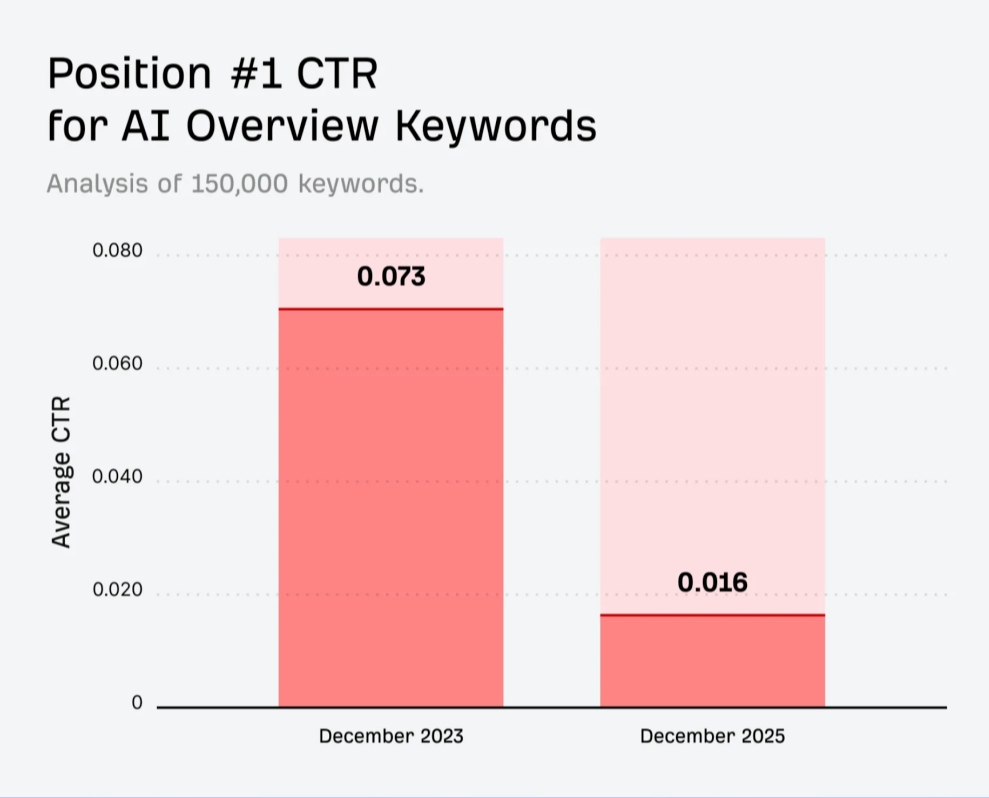
Taken together, the picture is unambiguous: users haven't gone anywhere, and search hasn't disappeared — but the click has quietly exited the equation.
The old contest was for clicks. The new contest is for being the name AI actually says out loud. These are two fundamentally different games.
3、Why This Hits Companies Going Global Especially Hard
Companies expanding internationally are first in line to feel this shift, for three converging reasons.
(1) AI has moved from the conversation layer into the decision layer.
G2's 2026 survey of 1,076 B2B software buyers found that 51% now turn to an AI chatbot more often than Google when starting software research, and 71% lean on one somewhere in the process. More striking still: AI chatbots have become the single biggest influence on a buyer's shortlist — 69% of buyers ended up choosing a different vendor than they'd originally planned, purely on an AI's recommendation, and a third bought from a company they'd never even heard of before that moment.
AI, in other words, has stopped being just an information tool. It's become the mechanism that decides who even gets considered. If your brand is absent from the answer, you may never make a buyer's first cut.
(2)International buyers are placing more trust in AI answers than ever before
TrustRadius's 2025 research found that 80% of tech buyers trust AI tools at least some of the time, up 19 points from the year before. G2's data tells a similar story: 85% of buyers say being mentioned by an AI directly improves their opinion of a vendor.
The real power of AI isn't that it skips due diligence. It's that it decides, ahead of time, which brands are even worth diligence on. That makes it a one-directional amplifier: brands that get named earn the chance to be scrutinized, trusted, and validated further; brands that don't often never get the chance to be considered at all.
(3)Companies going global often start with an information deficit
For companies going global, the real obstacle usually isn't product quality — it's the thinness of their English-language footprint. In SaaS, for instance, U.S.-based companies have spent the last decade accumulating a deep reservoir of reviews, comparisons, Q&As, and testimonials across G2, Capterra, TrustRadius, Reddit, Quora, YouTube, LinkedIn, and industry blogs. That content was once just SEO fuel — it's now also become a trust signal AI can retrieve, cite, and draw conclusions from.
TrustRadius's 2025 data shows 77% of tech buyers read user reviews, 54% talk to real users before buying, and 90% click through an AI Overview's sources to verify facts. G2 finds that citation frequency, review recency, and review volume all shape how much confidence buyers place in an AI's recommendation. Many Chinese companies expanding overseas — even ones with genuinely superior products — simply don't have the volume, longevity, or natural-language richness of English third-party content this requires.
The upshot: when AI casts its "vote" across the entire web's content, your ballot box starts out nearly empty.
The ground has already shifted. Now is the moment to act.
4、Four Things to Do Right Now
(1)Write content around how people ask, not what your brand wants to say.
This is the most fundamental shift GEO represents: moving from "push" branding to "pull" precision answers.
When someone asks an AI, "Best CRM for a 20-person team in Germany?" or "Cheapest cross-border payment option for the SEA market?", your website needs content that directly answers that exact question. We've seen this firsthand working with gaming companies entering overseas markets: players constantly ask AI about strategy guides and in-game character details. If there's no official English content addressing those questions, that traffic simply flows to third-party communities instead.
Restructure your website content around individual questions, with each concept following a simple pattern — one-sentence definition, a short explanation, and a concrete example. AI engines naturally favor citing content built this way.
(2)Localize meaning, not just words.
Running your website through Google Translate and calling it your English site is the most common — and most fatal — mistake overseas businesses make. Real localization goes deeper, into cultural habits and industry-specific terminology. A German B2B buyer searches for "DSGVO-konform" (GDPR compliant); a Japanese buyer searches for "インボイス対応" (invoice-system compliant). None of these terms will ever surface from a literal translation of your Chinese content. Start from the local market and the user's actual intent, and rewrite from there — don't just translate.
(3)Show up in native communities and answer real questions.
This isn't about gaming reviews or surface-level activity — it's about answering with your real name, addressing real questions, and bringing real authenticity. Have your product managers and customer success team answer questions on relevant subreddits under their own names. Encourage genuine customers to write detailed, scenario-specific reviews on G2. When AI generates comparison answers like "best X tool for Y," it draws heavily on user-generated content from these platforms — and weights it accordingly. Every genuine answer you give becomes a high-quality input into AI's knowledge base.
(4)Build a feedback loop to monitor what AI is actually saying about you.
If you can't measure it, you can't improve it.
Once your content foundation is in place, track how mainstream AI engines answer questions in your category at scale — whether you're mentioned, where you rank, and which sources get cited. Just as with SEO, this kind of monitoring is what turns GEO from guesswork into an engineering discipline driven by data. Continuous tracking is what lets you refine your content strategy with precision, so your brand's presence doesn't get drowned out in the AI era.
None of these four moves work in isolation — they require content, SEO, PR, product, and marketing to come together and rebuild a brand's digital presence as a single, coordinated effort.
Traditional search is losing its centrality, while AI search is becoming the new gateway.
For the last decade, the playbook for going global was about getting found on Google. For the next decade, it's about being named and recommended by AI. The former was a game of traffic. The latter is a game of substance — and under its rules, the earlier you commit, the further ahead you'll be.
The next battle for businesses going global won't be won on page one of the search results. It'll be won in the very first sentence AI generates.
END